
The Market Day
Why Markets and Technology Need a Beginning and an End

A Framework: Polis, Market, and Beyond
The city of Alba, in Northern Italy, is 2000 years old. It’s beautiful. You get the sense it knows what is doing on a certain level.
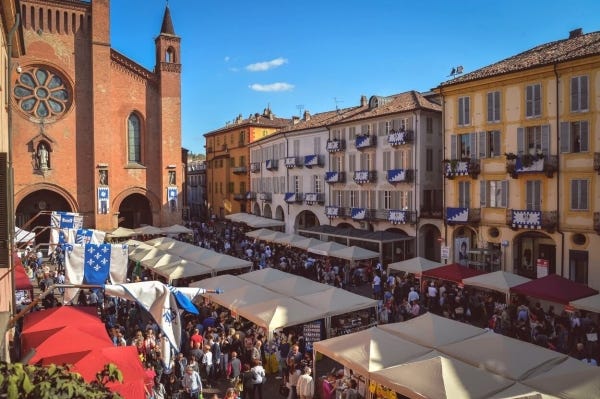
And every Thursday and Saturday, they have Market Days. On those days, vendors from the surrounding area sell food, flowers, and clothes in the main piazza, where they erect stalls in the morning and stay until afternoon. Palazzo Communale, the city hall building, looms overhead. The mayor could, if he chose to, watch the proceedings from his office window.
This is a Market: a finite time and place for exchange, which is formed and circumscribed by a Polis.
*
Consider, though, that these vendors need not have brought their wares to Alba. They might have gone to another city. They might even have gone to a different country. In this regard they are like shoppers in a “market for markets”.
Unlike the Market in Alba’s piazza, the open “market for markets” is not defined by an overarching political authority. Its shape is determined by countless chance factors, such as vendors’ ability to travel, and polities’ willingness to accept them. No one has much power over the overall shape of the market for markets—so no one can take much responsibility for it, either.
Thus there are many particular Markets: one in this city, another in that. But the “market for markets” has no outer boundary. It never closes. And every particular Polis’ Market in principle competes with every other one, so that there is only one “market of markets” in the whole world.
Therefore let us call the space of the market of markets the Open Field.
*
Within the Open Field, it happens that there is a certain amount of demand among vendors to sell their wares in Alba. This demand is a precondition for the city’s twice-weekly formation of a Market.
This demand is a kind of potential. (We might think of it like the “material” in Aristotelian metaphysics: the raw potential upon which the Polis impresses form in order to create a Market.)
But this is not the usual way of looking at things. Conventional economics does not distinguish between a Market and the Open Field. It says that wherever we find transaction, we must be looking at a Market. On this conventional view, accord of buyer and seller is what gives a Market reality and substance.
I say that what makes the Alba Market a Market is not mere transaction—which also happens out there in the Open Field—but the Polis’ definition of a place of exchange subject to limitations. Distinguishing between a Market and the Open Field lets us speak of transactions without a Market, and a Market without transactions. This is perfectly sensible: If nobody buys anything one sleepy Market Day in Alba, and all the sellers go home no richer than they arrived, we would still say that a Market opened and closed. Likewise, transactions often happen beyond the reach of a Polis, such as on the high seas, or in a dark alleyway with no one watching; and this is the Open Field, not a Market.
If we say that the hallmark of “markets” is transaction, not political circumscription, we lose our ability to distinguish between an orderly exchange of permitted goods, and an illicit secret deal. Failing to make this distinction is the source of huge practical confusion.
Transaction in the Open Field is antipolitical. It is barbarian commotion: powerful, yet undirected and chaotic. A Market is a Polis’s attempt to permit that energy into the city, to channel it toward the good, without corrupting the Polis. The circumscription of the Market is rarely perfect. Vendors might sell illicit wares in the alleys around the piazza, or cheat on their taxes, or keep their stalls open longer than the rules permit. But when transaction escapes political control, we should no longer say it is happening in a Market. This is the Open Field bleeding into the Polis.
*
If the transactions in the Open Field are entered freely, why shouldn’t the Polis simply celebrate it and encourage it? Why attempt to circumscribe the Open Field at all? Isn’t the Open Field potentially even better than the Market anyway—more dynamic, more bustling? Isn’t the Polis’ real enemy not the Open Field, but rogue highwaymen outside the city walls who impinge upon the Open Field by threatening free exchange with violence? So that defending the Open Field from violence, rather than creating definite Markets, ought to be the Polis’ main economic policy?
No.
But the question points toward another “place”: the place of violent actors outside the city. We might call it the Battlefield, which gives us four, so far:
a Polis, where politics excludes transaction;
a Market, where politics permits transaction;
the Open Field, where transaction excludes politics; and
the Battlefield, where violence excludes transaction.
A Polis and the Battlefield are opposites: a definite bubble of peace and order, versus an indefinite zone of violence and disorder.
In their pure form, both the Polis and the Battlefield exclude transaction. Markets and the Open Field form intermediate zones where transaction occurs against a non-transacting background, respectively the Polis and the Battlefield.
*
I think this is a fairly solid theoretical model, from which interesting insights follow. I will not try to explore them all now, but let me gesture towards a few.
Instability and the Role of Technology
The Open Field decays quickly into the Battlefield. Perhaps the pure Open Field—a peaceful libertarian paradise—can persist a while, amongst people accustomed to life in a Polis or a Market. But to imagine that this continue indefinitely is to imagine that you can run on on air (see below). In general, the Open Field only persists in the shadow of a Polis’ city walls. Without the influence of any Polis, goods in the Open Field are arrayed for the taking by the strongest, so that it becomes a Battlefield where any commerce depends on shipments in armored cars.

But a Market is unstable too. The buyers and sellers chafe against its limits: all things being equal, they might rather be meeting in the Open Field, free of taxes or restrictions. They will go to the authorities of the Polis and say so. But the Polis cannot give in to this: if it lets the Market overspill its limits and become an Open Field within the city, the Polis’ very essence, its maintenance of a moral order, is threatened. On the other hand, the Polis may grip the Market too tight, so that it is no Market at all, and what is happening there amounts only to more politics: people signaling alliances, paying tributes, and conferring favors. Then the Market is a pointless (and worse, deceptive) exercise: a political arena masquerading as a non-political one.
Markets persist only on this knife’s edge.
*
What is the role of technology in this landscape?
Technology’s true home is the Battlefield. It wins and loses wars and is honed in conflict. But it also thrives in the Open Field, where it brings some vendors huge fortunes and wipes out others.
It is constrained in a Market. It is extinguished in a Polis.
Is this an overstatement? I am not sure. Suppose some Polis has achieved both material stability and a genuinely satisfactory moral order—in short, political success. It should then want nothing more to do with technological change, whose dynamics could disrupt that balance. Only external competition or war would cause it to reevaluate.
Thus we might look at a Market as a Polis’ attempt to give limit and form not only to transaction, but also to technology—to put technology into the Polis’s service by letting it accelerate economic activity in a contained context where it will not undermine the Polis.
The catch-22 is that technology does not develop within the confines of a true, politically-delimited Market. It advances in the ungoverned spaces of the Open Field and, especially, the Battlefield. When a Polis allows the Open Field and the Battlefield into the city walls, it gambles its own integrity for the chance to capture and exploit the technological advancements which arise there, which may give that Polis temporary advantages over its neighbors.
A Polis that fails in this gamble transforms itself into the Open Field or, worse, the Battlefield.
*
Some 20th-century critics of technology tried to draw a line between older technology, which was supposedly more natural, controllable, and expressive of human creativity; and ultra-modern technology, which they regarded as more dehumanizing, autonomous, and oppressive.
These critics were not wrong to intuit some distinction between more manageable and less manageable technologies. But they revealed a certain degree of confusion by drawing that boundary, as they did, between larger late-modern works (mega-dams, jets, atom bombs) and smaller early modern devices (windmills, swords). Because countless pre-20th century technologies, too, were profoundly upsetting to political order. Good examples include the printing press, and before that the alphabet.
I think a more important distinction runs between the material and informational aspects of every technology: the distinction between an airplane, and the principle of an airplane’s construction. This is analogous to the distinction between a Market and the Open Field: the former is circumscribed and particular, the latter is formless and universal, even though an aspect of each is present in the other.
Material technology is less in need of delimitation by politics, because it is delimited by nature and physics. There is an important natural limit to what can be done with one, or ten, or even a hundred airplanes. But the principle of the airplane changes warfare forever.
In the same way that failing to control a Market can undermine a Polis, so can failing to control the informational dimension of a technology.
*
In the case of an airplane or an atom bomb, the information the Polis must control in order to perform its delimiting role is the principles or instructions sufficient for building the technology. But with information technologies such as computers and networks (and writing and printing), the technology itself effectuates the proliferation of such information. We are no longer talking about controlling blueprints, but controlling blueprint distributors; or, with AI, blueprint inventors.
*
Perhaps the original purely informational technology was money.
Aristotle’s Politics explained that money is compatible with the life of the Polis only if it is used exclusively for exchange, and not as a store of value. Why? A private actor who uses money as a store of value appropriates some of the credit of the Polis. When he saves money, he unilaterally diminishes the amount of credit that the Polis has placed into circulation; and when he decides to spend from his savings, he increases the amount of the Polis’ circulating credit; and he multiplies the Polis’ credit exposure if he lends with the expectation of interest.
Aristotle sometimes takes a beating from modern economic thinkers, but he wasn’t a bad economist; he wasn’t an economist at all. He was, instead, a good political scientist. The problem he recognized with money was that it had to be used in a very particular, restrained way, in order not to undo the Polis’ efforts at circumscribing extra-political forces. So it is with all information technology.
*
With AI, society likewise faces a technology that has the potential to puncture the integrity of politics. There is no simple solution to the problem; my hope is only that this model might help steer toward new ideas.
The Market, properly understood, is our historical precedent for the possibility of managing the energies of the Open Field within the Polis. So we should take note of its characteristics:
It happens in the town square, not in the dark alleys.
It opens and closes.
It is rule-governed; while it is operating, the police are never far away.
We cannot afford to be confused about the fact that successfully managing markets—and technology—has always required that the Polis maintain control and enforce limits.